At Enuclea, AI models like Google Gemini, ChatGPT, and Claude are an integral part of our everyday engineering workflow. But carrying that much compute capacity also means some of it sits idle during natural pauses in our operational day. Rather than let that unused capacity expire into the ether, we decided to put the slack toward education, public science, and a little inspiration.
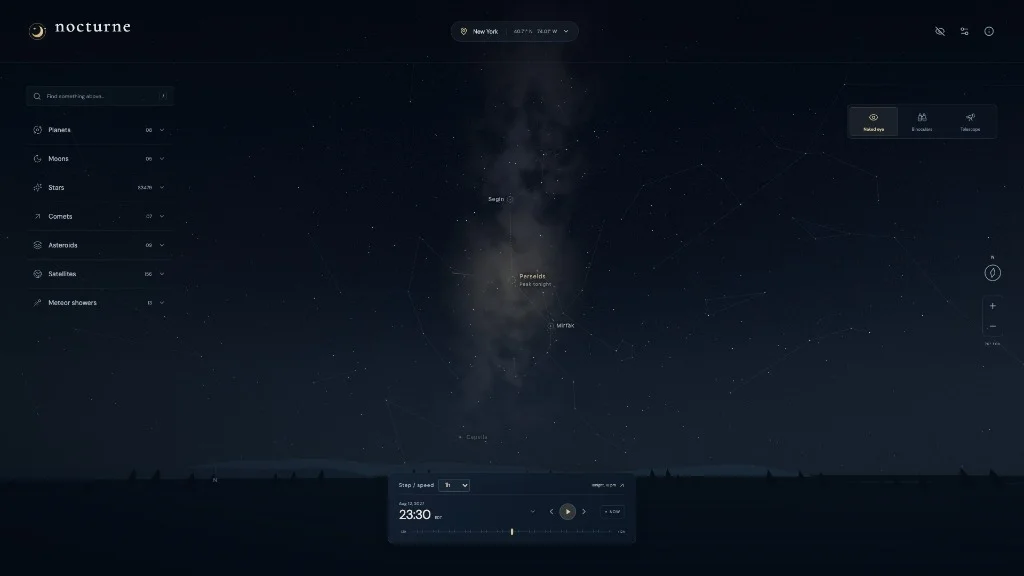
The first result of that effort is Nocturne, a full-featured planetarium that runs entirely in your web browser. It is completely free, requires no account, and carries no advertisements or trackers. Software with this depth used to cost real money and require dedicated desktop installs.
Nocturne also marks the opening of Vespertinum, our new umbrella for science, STEM, and open software development projects built in that same spirit.
What Nocturne Is (and What It Shows)
Nocturne renders the night sky above any coordinate on Earth, at any moment between the years 1900 and 2100. You drag to pan, scroll to zoom, and tap or click on any celestial object to inspect its properties.
Key features include:
- The Complete Sky: The planets, the Moon in its current phase, more than 83,000 cataloged stars, constellation boundaries, and an accurate rendering of the Milky Way.
- Temporal Scrubbing & Time Travel: Jump to tonight at 10:00 PM, scrub smoothly 12 hours backward or forward, or let time run forward to watch the sky wheel overhead.
- Intelligent Celestial Search: Search for any object and Nocturne swings your field of view directly to it. If the target is currently below your local horizon, it calculates exactly when it rises and offers to take you there.
- Live Comets, Asteroids, and Satellites: Orbital ephemerides update live from NASA JPL, while the brightest satellites—including the International Space Station (ISS)—display their upcoming visible passes.
- All 13 Major Annual Meteor Showers: Tied directly to the calendar. During an active shower, a soft atmospheric glow highlights the radiant point, anchored by prominent guide stars so you can find the origin in the actual sky.
- Optical Gear Modes: Switch seamlessly between naked-eye observing, 7x50 binoculars, and a small telescope to preview what your actual equipment can resolve.
- Zen Mode: When you just want to look at the stars without distraction, a single click clears away every interface overlay, leaving only the pristine sky.
How It Was Built: AI Assistance Meets Human Direction
Nocturne was conceived, built, and shipped using those same everyday AI assistants. The models wrote the underlying code, constructed the test suites, and even launched local browser sessions to visually inspect their own rendering passes.
Our role was editorial direction, systems architecture, and taste: deciding what to build, what to cut, and what didn't feel natural to an observer.
Most of our contributions were direct, one-sentence instructions:
"Add an eye icon that removes the superfluous text."
Now, a single button strips away the panels down to the raw starfield.
"Search should be smarter."
Now, the search dropdown only expands categories that actually have active matches for your query.
"Call out markers people can actually see."
Rather than directing observers to abstract celestial coordinates like Right Ascension and Declination that mean nothing to someone standing in a backyard, meteor showers point to bright, recognizable guide stars like Castor or Vega.
The precision of the engine isn't taken on faith. Nocturne runs 44 automated mathematical and visual verification checks. Among them is a test that recreates the total solar eclipse of April 8, 2024 over Dallas, Texas—confirming that the synthetic Sun and Moon align precisely down to the minute NASA's ephemeris recorded.
None of this means AI code is inherently flawless. But it proves that software which previously demanded specialized development budgets, or months of bespoke engineering, can now be produced by capturing the computational slack that modern tech companies already pay for.
Standing on Open Data
AI didn't invent astronomy, and it didn't discover orbital mechanics. Everything Nocturne calculates and displays stands directly on the shoulders of researchers, institutions, and open-source developers who publish their data and mathematics freely.
Our giving back starts by recognizing and linking to the primary sources:
| Source | What It Provides Nocturne | Terms |
|---|---|---|
| Astronomy Engine by Don Cross | Ephemeris calculations for Sun, Moon, and planetary positions | MIT License |
| HYG Stellar Database by David Nash | 83,479 stars compiled from Hipparcos, Yale, and Gliese catalogs | CC BY-SA 4.0 |
| D3 Celestial by Olaf Frohn | Constellation line geometry and celestial projections | BSD 3-Clause |
| NASA JPL Horizons & Small-Body Database | Live orbital elements for comets and near-Earth asteroids | Public NASA Data Service |
| CelesTrak by Dr. T.S. Kelso | NORAD two-line element sets (TLEs) for satellite tracking | Public Data |
| satellite.js by Shashwat Anand | SGP4/SDP4 satellite orbit propagation mathematics | MIT License |
| International Meteor Organization | Annual meteor shower calendars, peak dates, and radiant coordinates | Published Science Calendar |
| Open-Meteo | Global city geocoding, coordinates, and local time zones | Free Public API (CC BY 4.0) |
Honest Limitations: What Nocturne Can’t Tell You
Nocturne calculates where objects are located in space, not whether you will actually see them from your driveway. It knows nothing about tonight’s cloud cover, local streetlights, or the mature oak tree in your neighbor’s yard.
When designing educational tools, honesty about physical reality is paramount:
- Visibility is ideal-case: The naked-eye, binocular, and telescope limiting magnitudes assume pristine, unpolluted dark skies. Suburban skies with light pollution will reveal far fewer faint stars.
- Meteor rates are theoretical best-case: A shower's Zenithal Hourly Rate (ZHR) assumes a pitch-black sky with the radiant directly overhead at zenith. In the real world, expect a fraction of that number.
- Comets are volatile: Cometary outgassing and brightness curves are notoriously unpredictable. Forecasted magnitudes frequently miss in both directions.
- The horizon is illustrative: The tree and hill silhouettes along the bottom are a decorative visual baseline, not your specific neighborhood elevation profile.
Nocturne openly states these caveats in its own interface. A tool designed to teach people about the universe should never overpromise what human eyes will see when they step outside.
Why We’re Doing This: Giving Slack a Purpose
When a technology company relies heavily on AI subscriptions and compute capacity, it faces an ongoing choice: let the leftover capacity expire on each billing cycle, or channel that surplus into something that teaches and endures.
It has always surprised us how little the average person knows about the sky directly over their head—not out of disinterest, but because most people never had a patient, accessible guide. The best commercial astronomy tools often hide behind paywalls, subscription fees, or intrusive ads.
Capturing unused compute capacity can help close that gap. A teacher in a science classroom, a parent answering bedtime questions, or a curious kid can load Nocturne in seconds, without a login or credit card, and explore the cosmos.
That is the founding mission behind Vespertinum: science, STEM, and creative development projects made freely accessible to the public. Nocturne is our first release under that banner, and more will follow.
So when the sky clears tonight, step outside, open nocturne.vespertinum.com, and look up.
Explore the night sky in your browser, or discover our open science and educational initiatives:
Related Resources
- Managed IT in Stafford, VA — Monitoring, patching, MDR, and support
- Case Studies — See how we've helped businesses like yours
- All Services — IT support, network design, and security

