A lot of the work finds us the same way it finds a plumber or an electrician.
Someone has been running a real business — hiring, selling, making payroll — and the technology has been “fine.” Then it isn’t. A machine won’t boot. Email stops. A laptop that holds the only copy of something important starts making a sound no one likes. They open Thumbtack, or something like it, and look for a competent human.
That instinct is reasonable. The people making the call are usually not careless. They are founders and operators who have been putting money into the parts of the business that feel productive.
IT, before a disaster, feels like overhead. After a disaster, it feels like the only thing that matters.
The Problem Sits Under the Ticket
The pain is real. It is also incomplete.
Nearly every time we walk into one of these situations, the thing that finally hurt is the smallest part of the picture.
I just got off another call with an owner. Same pattern we see constantly:
- The operating system was set to update automatically — so on paper everything looked responsible.
- In practice, the machines never rebooted, so critical security patches sat waiting indefinitely.
- Third-party software had never been updated at all; Windows Update doesn't touch line-of-business applications.
- And the front-desk computer — not the one we were called to fix — had thirty-seven privacy issues flagged as potentially unwanted programs and one actual virus.
That machine wasn't broken. It was just quietly collecting problems while everyone focused on the one that had finally complained.
What "Tech Debt" Actually Looks Like
This is what tech debt usually looks like in a small office: licenses bought twice because no one kept a list, antivirus subscriptions that lapsed without anyone noticing, backups that exist in name only, and a quiet assumption that "automatic updates" means the work is done.
The owner feels a single failure. Underneath it is years of unattended drift.
That is not a moral failing. It is what happens when a business is built by people who are good at their craft and treat computers as tools instead of systems.
The Core Rule: Tools get used until they break. Systems have to be watched.
The Marketplace Roulette
Marketplace platforms are built for the first model. Pay someone to show up, learn the environment from scratch, and fix the symptom.
The platform has to take a cut, so the hourly rate is often above what the same work would cost directly. The other option is value shopping: the lowest bid, a new set of hands, unknown judgment, trusted with the books, the client list, and whatever happens to be sitting on the desktop.
Every time a one-off tech shows up, you pay an "onboarding tax" to have someone learn your building from the sidewalk.
That is not a partnership. It is roulette with the business.
The Tone Always Changes After the Outage
Before something fails, spending on IT feels like buying insurance for a house that has never had a fire.
After something fails, the same owner will often swing hard the other way — ready to overbuy tools, lock into a fat contract, or treat every vendor pitch as salvation.
Neither extreme is useful.
The useful question is quieter, and it should be asked while the lights are still on:
- Attended Monitoring: Are the machines actually being watched for problems, or only noticed when a person cannot work?
- Current Protection: Is antivirus current on every endpoint, or only on the one that was set up last?
- Applied Patching: Are patches landing and being applied (including the reboot), or is “Windows Update” somebody’s side chore that never finishes?
- Third-Party Maintenance: Are third-party applications being updated at all?
- Verified Backups: Have the backups been restored — not just scheduled?
- Institutional Memory: When something does head south, is there a number to call that already knows the environment?
Those are not luxury items. They are the difference between an afternoon inconvenience and a week you cannot invoice.
What "Someone Who Already Knows the System" Actually Means
It does not mean a dashboard you never look at, or a bundle that prices labor you may never use.
It means a baseline that stays boring on purpose:
- Monitoring that is attended. Disks filling, failed updates, machines that drop off the network, security alerts that are not left blinking at 2 a.m. Software can detect. A person still has to decide.
- Protection that does not expire in silence. Endpoint coverage, patching (including the reboot), third-party software updates, and the unglamorous work of keeping licenses from doubling and subscriptions from dying.
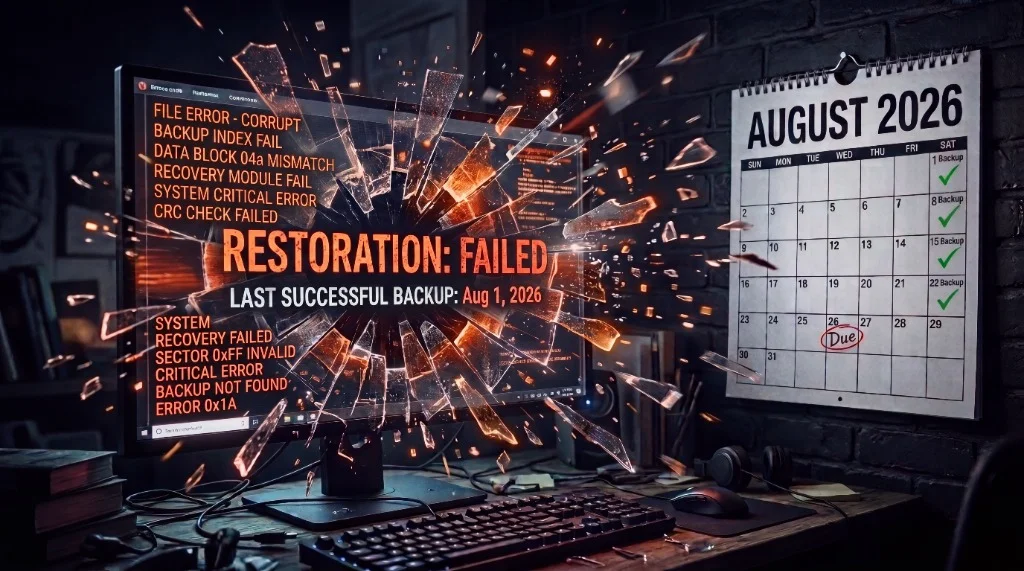
- Backups that have been pulled back. A backup that has never been restored is a hope. A scheduled job can log green checkmarks every Saturday for a month, but if the recovery volume is corrupted when a major deliverable is due on Wednesday, you don't have backups—you have three weeks of lost work. Hopes do not reopen the office on Monday.
- A number that is not a lottery ticket. When something breaks — or when you simply need help making a decision — you should not be paying someone to learn your building from scratch.
That is the work we built Enuclea around. Not another stack of tools. Not a contract designed to outgrow the client. Clear language, predictable costs, and systems that stay out of the way so the business can stay loud.
We still take the Thumbtack call. The door is fine. What we refuse to do is treat the door as the whole house.
If the last year of your IT has been “we’ll deal with it when it breaks,” the honest time to look is now — while the failure is still hypothetical. A short conversation is enough to see whether the surface problem is the only one you have.
Zero Jargon. Transparent Support.
If you want an honest assessment of what is actually running on your network before an outage forces the issue, let's have a 15-minute conversation.
Related Resources
- Managed IT in Stafford, VA — Monitoring, patching, MDR, and support
- Case Studies — See how we've helped businesses like yours
- All Services — IT support, network design, and security

