63% of Stafford Businesses Send Unsigned Email
Stafford County Digital Trust Audit — a study of email authentication across 149 local businesses
Published March 6, 2026 · Data acquired March 6, 2026
We studied email authentication records across 149 Stafford County businesses to understand how well the local business community is positioned against impersonation, spoofing, and deliverability failures. The results reveal a clear gap between intention and implementation.
County Snapshot
Key findings from 149 Stafford County business domains
These are not obscure technical details. SPF, DKIM, and DMARC are the three standards that determine whether your email is trusted, delivered, and protected from impersonation.
Why This Matters in Stafford
A county with unique trust requirements
Stafford County is not a typical suburban market. It sits at the intersection of federal workforce commuters, military families connected to Quantico, and a growing base of small businesses that serve both local and government-adjacent clients.
When a Stafford business sends an invoice, a proposal, or a routine follow-up, the recipient's mail system makes a trust decision in milliseconds. Without proper authentication, that message may be flagged, filtered, or rejected entirely — and the sender never knows.
For businesses operating near one of the country's most security-conscious installations, the gap between "we have email" and "our email is authenticated" carries real consequences: lost invoices, missed opportunities, and an invisible erosion of professional credibility.
The good news: these are solvable problems, and most fixes take less than an afternoon.
Security Readiness by Sector
How different industries in Stafford County compare
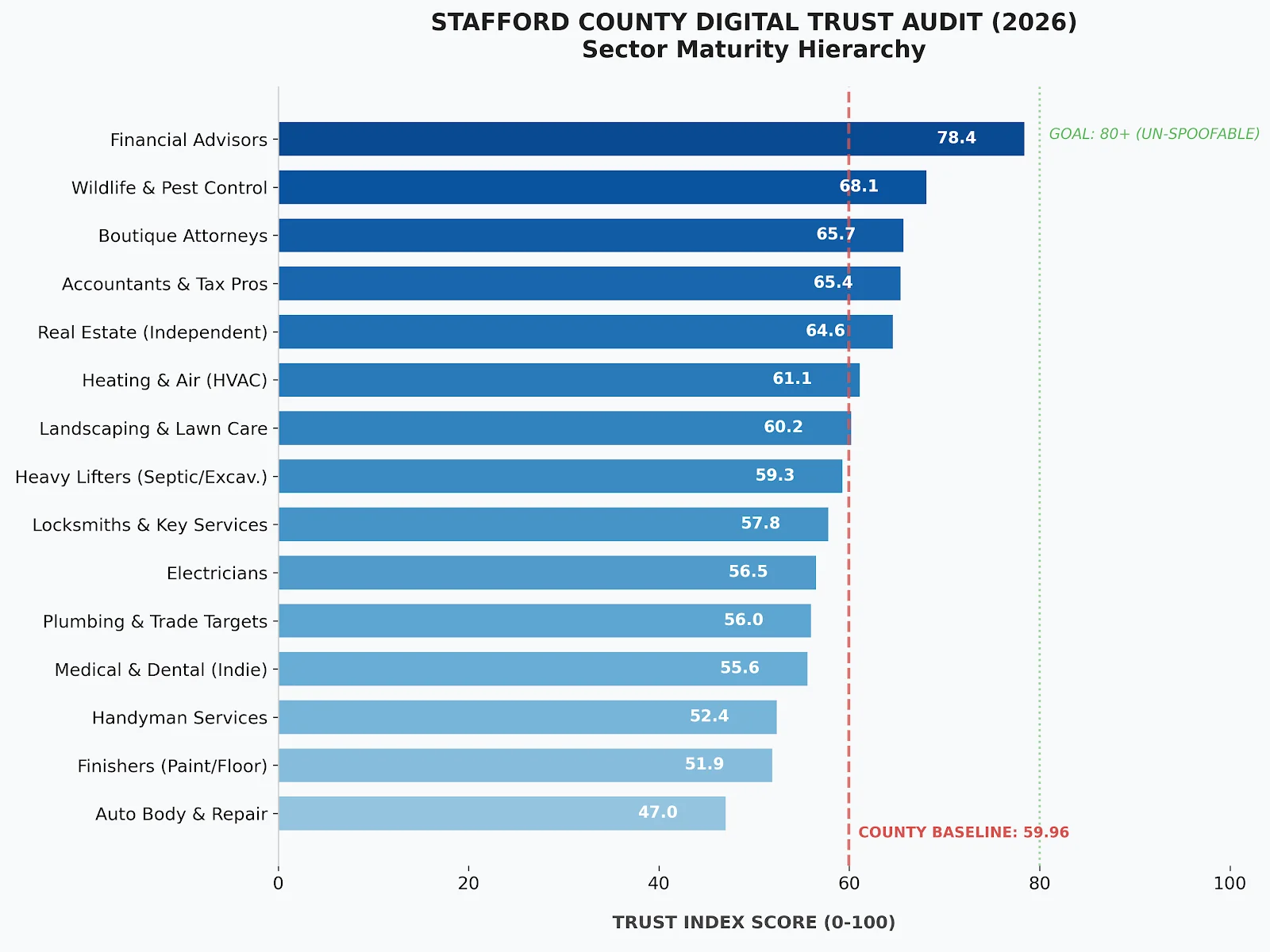
Some sectors — particularly those with regulatory or compliance exposure — show stronger authentication adoption. Others, including many service-oriented small businesses, have significant gaps that leave them vulnerable to impersonation and deliverability issues.
What Businesses Can Do Right Now
Three straightforward steps to strengthen your email trust
Check Your Domain
Run a free scan to see where your SPF, DKIM, and DMARC records stand today. It takes less than a minute and requires no technical knowledge.
Publish the Basics
Most email authentication gaps can be closed by adding a few DNS records. Your IT provider or email host can usually do this in a single session.
Monitor and Enforce
Once your records are in place, move toward a DMARC enforcement policy so unauthorized senders can't use your domain to impersonate your business.
How Does Your Business Compare?
This audit analyzed 149 local businesses across 15 sectors. The average Stafford County trust score was 59.96 out of 100.
Our free domain check evaluates the same signals used in the report — SPF authorization, DKIM email signing, DMARC monitoring, and free-mail usage — and shows whether your business scores above, below, or in line with the county baseline.
Compare My DomainTakes about 30 seconds. No account required — results are private to you.
Download the Research
Both reports are free and available without registration
Executive Brief
A concise overview of the audit findings, key statistics, and recommendations. Ideal for sharing with leadership or partners.
Download Executive Brief (PDF)Full Report
The complete audit with sector-by-sector analysis, methodology details, and the full dataset summary. For those who want the full picture.
Download Full Report (PDF)Methodology
How the audit was conducted
The Stafford County Digital Trust Audit examined publicly available DNS records for 149 business domains operating in Stafford County, Virginia. Domains were identified through local business directories, chamber of commerce listings, and public registration data.
Each domain was evaluated for the presence and configuration of three email authentication standards: SPF (Sender Policy Framework), DKIM (DomainKeys Identified Mail), and DMARC (Domain-based Message Authentication, Reporting, and Conformance).
The audit assessed only publicly visible DNS records. No email traffic was intercepted, no systems were accessed, and no private data was collected. The study reflects a point-in-time snapshot of authentication posture as of March 6, 2026.
Sector classifications were assigned based on publicly available business descriptions and may not reflect every business's self-identified category.
About Enuclea
Veteran-owned IT support based in Stafford, VA
Enuclea provides managed IT services, email security, and infrastructure support for small businesses in Stafford, Fredericksburg, and Northern Virginia. We work with companies under 50 employees who need reliable, quiet IT — systems that stay out of the way and let the business run.
This audit was conducted as part of our commitment to understanding and improving the digital trust posture of the local business community. The findings are published openly because we believe transparency about these issues benefits everyone — not just our clients.
Frequently Asked Questions
Common questions about the audit and email authentication
What is a Digital Trust Audit?
A Digital Trust Audit reviews the publicly visible email authentication records — SPF, DKIM, and DMARC — for a group of business domains. It measures how well those businesses are positioned to send trusted email and resist impersonation. No private data is accessed; the audit examines only DNS records that are already public.
Why does DMARC matter for small businesses in Stafford County?
DMARC tells receiving mail servers how to handle messages that fail authentication checks. Without it, anyone can send email that appears to come from your domain. For Stafford businesses — many of which work with government-adjacent clients or military families — that kind of impersonation risk can undermine trust and lead to lost business.
How do I know if my business email is properly authenticated?
You can run a free domain check using the same signals evaluated in this audit. The scan takes about 30 seconds and shows whether your SPF, DKIM, and DMARC records are in place, misconfigured, or missing entirely. Check your domain here.
Is email authentication difficult to set up?
For most small businesses, the core records can be added in a single session with your IT provider or email host. SPF and DMARC are DNS text records, and DKIM is typically enabled through your email platform. The technical lift is modest — the harder part is usually knowing what to check in the first place.
Start With a Free Domain Check
See where your business stands in less than a minute. No account needed, no obligation.
Questions about the audit or your results? Get in touch — we're happy to help.