Facebook Tracking Pixel
Loading...
Schedule a Conversation

NORTHERN VIRGINIA SMB MATURITY AUDIT

EMAIL SECURITY MATURITY AUDIT

Misconfigured email makes your business an easy target for impersonation. Audit your SPF, DKIM, and DMARC to secure your domain—without risking legitimate email delivery.

We only query public DNS records. You can request deletion anytime.

We respect your data. See how we handle your info in our
Privacy Policy.

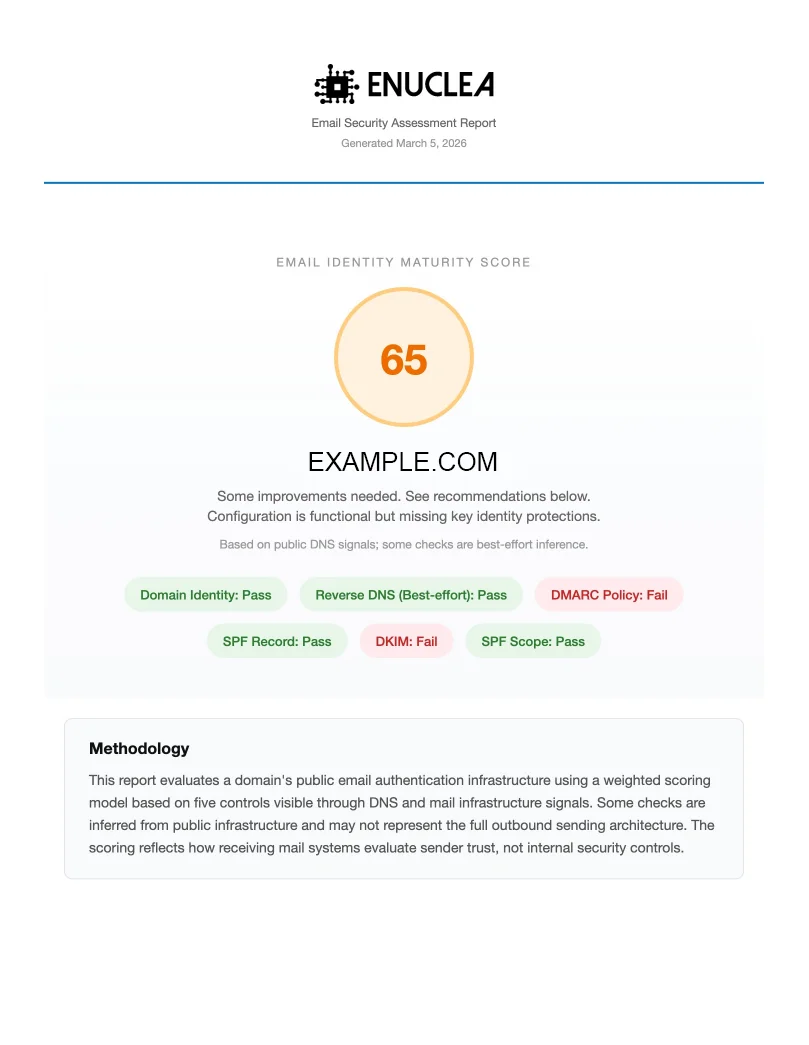
Example Email Security Report

Example report for illustration. Your results will reflect your domain's actual configuration.

This is a typical configuration we see when companies rely only on their mail provider's default setup.

How Scoring Works

The Email Identity Maturity Score uses a layered model that separates identity authentication from infrastructure trust, plus a separate reputation modifier. A score of 70+ indicates solid deliverability. Below 40 means critical issues.

Why does this matter?

Identity Authority (85 points)

Measures whether a domain has implemented authentication controls to prove legitimate ownership of outbound email.

35
Domain Identity
15
SPF Record
10
DKIM
25
DMARC Policy

Infrastructure Trust (15 points)

Evaluates supporting infrastructure signals used by receiving mail systems to assess sending legitimacy.

15
Reverse DNS

Reputation Signals (Penalty Modifier)

Spam listings apply a separate penalty to reflect increased deliverability risk. Maximum penalty: -15 points.

0 listings
0
1 listing
-5
2 listings
-10
3+ listings
-15

Understanding Email Deliverability

What is SPF?

Sender Policy Framework (SPF) is a DNS record that lists which servers are authorized to send email for your domain. Without SPF, anyone can send email pretending to be you. Gmail and Outlook check SPF on every incoming message—if it fails, your email goes to spam or gets rejected.

What is DKIM?

DomainKeys Identified Mail (DKIM) adds a cryptographic signature to your emails. The receiving server verifies this signature against a public key in your DNS. DKIM proves your email wasn't tampered with in transit and came from an authorized sender.

What is DMARC?

Domain-based Message Authentication, Reporting & Conformance (DMARC) tells receiving servers what to do when SPF or DKIM fails. A DMARC policy of "reject" means unauthenticated emails are blocked entirely. Without DMARC, spammers can spoof your domain freely.

Why Custom Domains Matter

Free email (@gmail, @yahoo) shares infrastructure with millions of users—including spammers. Corporate security filters flag these as higher risk. A custom domain gives you a dedicated sending reputation and allows proper SPF/DKIM/DMARC configuration.

Reverse DNS (PTR Records)

Reverse DNS maps an IP address back to a hostname. Email servers check that your sending IP's PTR record matches your domain. Mismatched or missing PTR records signal "possibly spam" to receiving servers—especially Gmail's filters.

The Spam Folder Problem

When your emails land in spam, clients don't see your invoices. Proposals go unread. Follow-ups vanish. The fix isn't sending more emails—it's configuring your domain's DNS records correctly so you pass authentication checks.

Book an Email Fix

Calculate Price Call Us Email Icon Contact Us Shield Icon Free Email Scan