When you launch a solo business, your first instinct is to keep overhead as close to zero as possible. You buy a domain, sign up for a basic email account, find a free cloud drive, and patch it all together. It feels like you're being lean, agile, and financially responsible.
But the reality of business technology is deeply counterintuitive: piecing together a bare-minimum IT setup usually costs you significantly more in the long run.
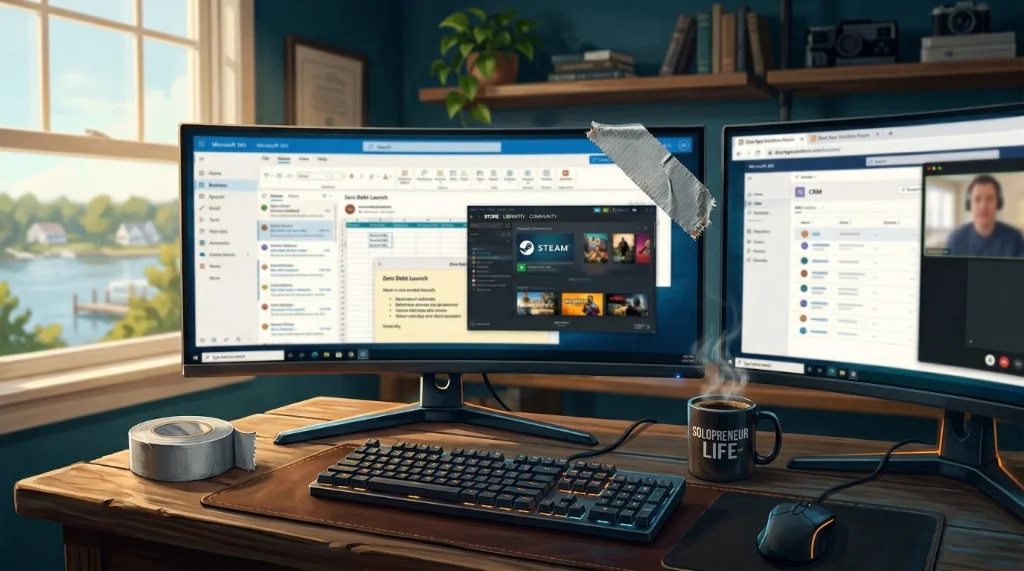
If your setup looks like it’s being held together with duct tape—it probably is.
While it’s easy to focus on keeping your monthly software subscriptions low, the true cost of a "DIY" tech stack lies in its structural vulnerabilities and hidden inefficiencies. Let’s look at the three critical areas where a duct-taped approach quietly drains your business—and why doing it right from day one is the smartest financial move you can make.
1. The Email Deliverability Gamble
Most solopreneurs assume that once they pay for an inbox, their emails will seamlessly reach their clients. Unfortunately, modern email doesn’t work that way.
If your backend domain records (SPF, DKIM, DMARC) aren’t properly configured, your emails don’t just look unprofessional—they disappear.
And you won’t even know it’s happening.
A basic, unconfigured email setup directly costs you leads, delayed contract signings, and lost revenue. Professional, enterprise-grade email requires identity management that guarantees your message actually lands where it's supposed to, every single time.
2. The Illusion of "Too Small to Hack"
There is a dangerous, lingering myth among solo operators: "I'm too small to be a target." The data tells a very different story. Cybercriminals disproportionately target microbusinesses precisely because they know you don't have an IT department. When you rely on basic antivirus or consumer-grade cloud storage, you are completely on your own to defend against account takeovers (ATOs), phishing, and ransomware.
Furthermore, what happens if your primary laptop simply dies? A consumer cloud drive might save files—but it won't restore your business. True business continuity requires immutable backups (which can't be deleted or encrypted by ransomware) and full workstation imaging. If you aren't backed up at an enterprise level, a single hardware failure can paralyze your business for days.
3. The Silent Tax on Your Time
This is the cost most solo operators never see on a balance sheet. You probably don't even realize you're doing it, but the time spent managing a fractured tech stack adds up rapidly.
It’s the 20 minutes spent Googling why an email bounced. It’s the late-night forum deep-dive trying to figure out which CRM integrates with your inbox. It’s the mental fatigue of jumping between a half-dozen disconnected, overlapping apps.
Studies show that self-managed IT and digital friction quietly consume hours of your week. When you are the sole revenue generator for your business, every hour you spend acting as your own IT support desk is an hour you aren't doing billable client work.
You might think you’re saving $40 a month. In reality, you’re trading billable hours for troubleshooting.
Stop Guessing. Start Scaling.
The math doesn’t work.
A piecemeal setup might cost $60/month on paper—but it introduces risk, downtime, and lost hours that far outweigh the savings.
For a relatively small increase in cost, you can start with a properly configured, secure, and fully integrated stack from day one—email that delivers, devices that are protected, and backups that actually restore your business when something goes wrong.
The gap between “duct-taped” and “enterprise-grade” is smaller than most solopreneurs think.
The difference is whether your technology slows you down—or silently scales with you. (This is exactly what structured frameworks like the Zero-Debt Business Launch are designed to solve.)
Duct tape is for quick fixes. Your business deserves a foundation.
Stop duct-taping your business technology. Contact us today or explore our dedicated launch package for new business owners.
Related Resources
- Managed IT in Stafford, VA — Monitoring, patching, MDR, and support
- Case Studies — See how we've helped businesses like yours
- All Services — IT support, network design, and security

