

After the Platform Said Delivered: Residual Phishing in a 10-Mailbox Manufacturer
How an anonymous 10-mailbox building-products manufacturer running Microsoft 365 handled 411 residual phishing threats with autonomous post-delivery clawback.
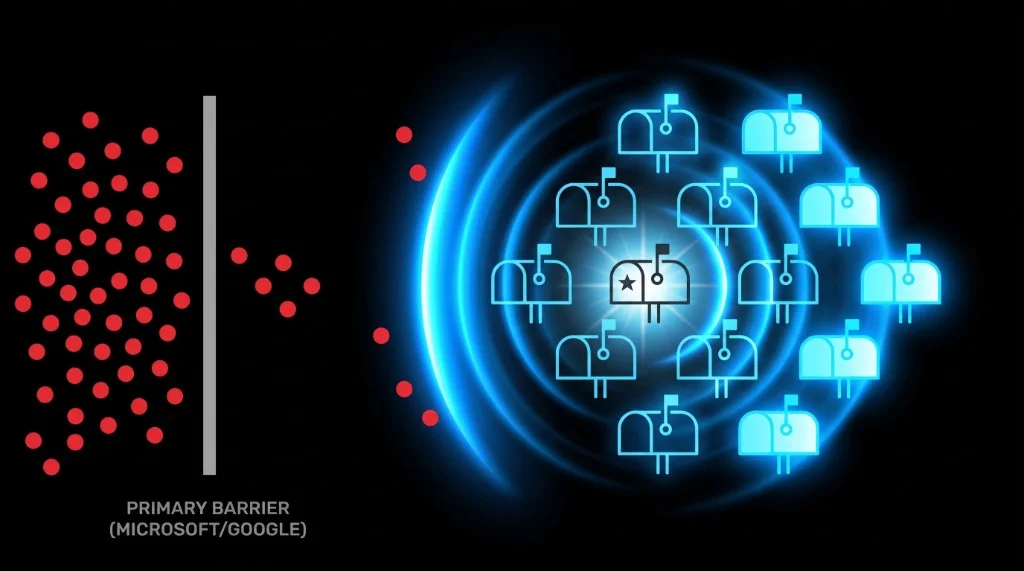
Native email security is very good at catching obvious spam. It is not the last word.
This case study reviews real operational telemetry from an anonymous U.S. specialty building-products manufacturer. The company operates an e-commerce storefront and manages daily operations across ten Microsoft 365 mailboxes: shared inboxes for info@, sales@, and accounting@, a handful of named employees, and the owner. Nobody on staff is a security analyst.
Before any data in this file was recorded, Microsoft’s native platform filter (Exchange Online / Defender) had already evaluated, accepted, and delivered every single message into user inboxes.
What follows is what still required a second look—and what happened when a continuous mailbox layer took over.
[challenge]
A ten-person manufacturer represents the size most commercial businesses actually are. They face four structural email security realities:
- "Delivered" Is Not "Safe": Gateway filters stop bulk junk, but they miss authenticated impersonation, newly registered domains with clean first hours, and links that turn malicious after delivery.
- The Front Door Problem: Attacks do not land evenly. The public
info@address and the owner's personal mailbox absorbed 64.8% of all threat volume, whileaccounting@faced invoice-shaped lures (including an E-ZPass toll fraud campaign during peak shipping season). - The Multi-Recipient Clawback Surface: 485 threat incidents fanned out into 826 individual mailbox deliveries. When a phishing email hits multiple inboxes simultaneously, one person deleting it leaves everyone else exposed.
- The 21-Second Window: Industry telemetry (Verizon DBIR) shows the median time between an employee opening a phishing email and clicking a malicious link is just 21 seconds. With beginner-level security awareness, relying on human perfection is not a viable defense.
[/challenge]
[solution]
Enuclea deployed a continuous mailbox-security layer operating via API directly inside Microsoft 365:
- Autonomous Post-Delivery Clawback: Messages are continuously evaluated post-delivery. When an email is confirmed malicious anywhere, the system instantly purges it across all ten mailboxes simultaneously.
- Continuous URL & Attachment Sandboxing: Inspected 1,087 live links and sandboxed 58 attachments as threat infrastructure shifted in real time.
- Federated Threat Intelligence: Ingested global community detection feeds, identifying 19.7% of threats before local indicators were established.
- Exception-Only Human Triage: Handled 97.1% of incidents autonomously, routing only ambiguous edge cases to Enuclea analysts for manual verdicting.
[/solution]
[results]
The second layer turned what would have been a high-risk operational burden into a silent, zero-backlog background process:
- Zero Left Open: Analyzed 411 residual threat incidents in 2026 YTD; 399 were quarantined and purged automatically. Backlog stayed at zero through heavy spring campaign spikes (98 incidents in March, 106 in May).
- 155+ Hours of Triage Labor Saved: Applying the Osterman Research labor benchmark ($27.51 / 23.2 min per phish), autonomous handling prevented 155.4 hours of staff distraction—equivalent to ~$11,100 in labor value.
- 9.25× Direct ROI on Labor Alone: At Enuclea’s standard rate of $10/seat/month ($1,200/year for 10 seats), labor savings alone covered the cost of the layer more than nine times over.
- Catastrophic Risk Shield: Intercepted an estimated 14 live clicks, 8 credential submissions, and multiple BEC wire-fraud lures, shielding against the FBI IC3 $50,000 median BEC loss.
[/results]
[testimonial]
"You do not buy a second security layer because Microsoft is bad. You buy it because being right 99.5% of the time is how a quiet shop gets surprised." — Enuclea Mailbox Telemetry Finding
[/testimonial]
[technical]
1. 2026 YTD Residual Threat Telemetry (10-Mailbox Tenant)
All figures represent malicious or suspicious mail delivered past native Microsoft 365 filtering from January through late August 2026:
| Telemetry Metric | Recorded Value | Operational Context |
|---|---|---|
| Total Incidents Analyzed | 411 | Messages delivered by gateway, flagged post-delivery |
| Classified Phishing | 402 (97.8%) | Hostile credential harvesters, BEC, and payload lures |
| Classified Spam / Graymail | 7 (1.7%) | Bulk marketing bypassing initial filters |
| Verified Safe | 2 (0.5%) | Legitimate vendor communications cleared on review |
| Left Open / Unresolved | 0 (0.0%) | Zero unmanaged queue sitting in user mailboxes |
| Live Links Inspected | 1,087 | Embedded URLs analyzed post-delivery |
| Attachments Sandboxed | 58 | Invoices, statements, and archive attachments |
| Messages with Live Links | 230 (56.0%) | Active URL payloads requiring deep inspection |
| Lifetime Incidents (since Dec 2025) | 485 | Total campaigns intercepted |
| Lifetime Mailbox Placements | 826 | Total individual inbox clawbacks executed |
2. Threat Distribution by Mailbox Role
Threat actors concentrate effort on public contact forms and executive mailboxes:
| Mailbox Role | Incident Count | Share of Total | Primary Attack Vectors |
|---|---|---|---|
Public Info Box (info@) | 156 | 38.0% | Web-form scrapes, SEO pitches, fake RFQs |
| Primary Operator / Owner | 110 | 26.8% | Executive BEC, wire redirection, vendor spoofing |
| Director / Management | 49 | 11.9% | Authority lures, internal impersonation |
Sales Desk (sales@) | 39 | 9.5% | RFQ attachments, purchase order lures |
Accounting (accounting@) | 27 | 6.6% | Fake invoices, E-ZPass toll fraud, ACH updates |
| Returns / Support | 16 | 3.9% | Customer dispute lures, fake chargebacks |
| Personal Alias | 13 | 3.2% | Direct personal targeting |
3. Economic Analysis: Cost vs. Avoided Risk
Comparing annual protection cost against industry labor and breach benchmarks:
| Benchmark / Category | Metric Source | Financial Value | Multiple vs. $1,200/Yr Cost |
|---|---|---|---|
| Annual Protection Cost | Enuclea ($10/seat/mo × 10 seats) | $1,200 / year | Baseline (1.0×) |
| Triage Labor Saved | Osterman Research ($27.51/phish × 402) | ~$11,100 | 9.25× annual cost |
| Lifetime Labor Saved | Osterman Research ($27.51/phish × 473) | ~$13,000 | 10.8× annual cost |
| Median BEC Incident Loss | FBI IC3 Small Business Average | ~$50,000 | 41.6 years of protection |
| Small-Firm Incident Range | SMB Forensics & Remediation Surveys | $50,000 – $200,000 | 42 to 166 years of protection |
4. Architecture: The Post-Delivery Remediation Loop
graph TD
    A["Inbound Email Stream"] --> B["Microsoft 365 / Defender Gateway"]
    B -->|"Delivered to User Mailboxes"| C["10 Protected Inboxes"]
    C --> D["Second Layer Mailbox API Telemetry"]
    D --> E{"Continuous Threat Analysis"}
    E -->|"97.1% (399) Quarantined Autonomously"| F["Cross-Mailbox Instant Clawback"]
    E -->|"19.7% Federation Threat Feeds"| F
    E -->|"0.7% (3) Human Analyst Verdict"| F
    F --> G["Zero Residual Threats Left in Inboxes"]
Is your email defense relying on human perfection? Start with a baseline conversation to see what is currently reaching your team's inboxes.
[/technical]
See the email defense and 24/7 security platforms used in this engagement:
Book a free 15-minute call with Founder Daniel Quigley-Skillin (schedule online ↗ — 24-hour advance notice) or call our Stafford dispatch line directly at (703) 239-4620.