

The Real Math Behind "Unlimited" IT Support
Does hourly IT cost more than an "unlimited" retainer? An engineer breaks down the 160-hour math, what flat-rate contracts quietly exclude, and why a 5-minute call handles most of the rest.
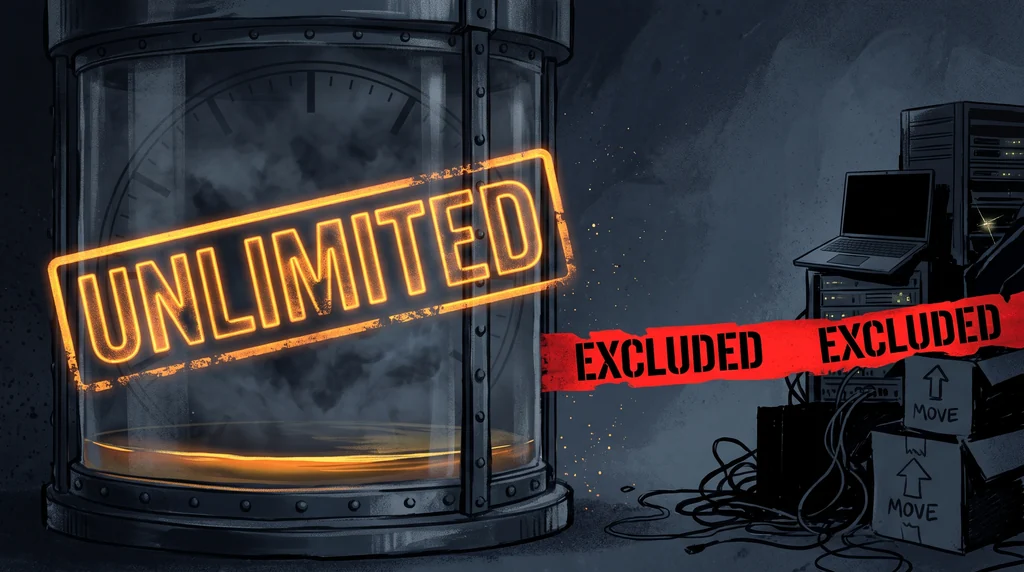
From the engineer's desk, I'm often asked whether hourly IT support will end up costing more than an "unlimited" flat-rate contract.
The answer, most of the time, is no.
And it has nothing to do with clever sales math. It comes down to simple arithmetic about how an engineer's week actually works—and what "unlimited" really covers once you read past the headline.
The 160-Hour Reality Check
Start with the basic constraint every IT firm lives inside: an engineer has a finite amount of time.
For the sake of argument, call it 40 hours a week—about 160 hours a month—and a real paycheck, benefits, and overhead to cover that time. A $2,000/month "unlimited" managed IT contract obviously doesn't buy you 160 hours of an engineer's month. Not even close.
That single fact explains the real math behind the flat-rate game.
To make an "unlimited" retainer profitable, most MSPs work backwards from averages—tracking industry metrics like TruMethods' Reactive Hours per Endpoint per Month (RHEM) to calculate how many seats a single technician can carry. To protect their margin against the noisiest accounts in their portfolio, many shops bake an estimated 1 to 2 hours per seat, per month of helpdesk cushion straight into their default per-seat fee (usually $125–$165/seat for a starter tier—before Microsoft 365 licenses, business phones, or a 24/7 MDR upgrade).
Statistically, for a well-maintained small office, that's 1 to 2 hours per seat you won't use—billed every single month.
Let that settle in. On a 10-person office, you are prepaying for 10 to 20 hours of monthly hand-holding whether anything breaks or not.
Across Enuclea's managed small-business clients (full-year 2025 data), actual billable hands-on labor for a typical 5-seat office averaged 2.75 hours per month total—roughly half an hour per seat, including equipment rollouts and project work. Quiet months often come in at zero or one hour. When systems are patched, monitored, and built cleanly in the first place, they don't generate a steady stream of emergencies.
What "Unlimited" Actually Covers — vs. What It Quietly Excludes
Even before you look at the hours, look at the scope boundary written into almost every traditional "all-you-can-eat" agreement. This isn't an industry secret—it's standard MSP contract playbook. NinjaOne's MSP scope-document guide explicitly instructs providers to separate routine recurring maintenance from out-of-scope exclusions like major OS upgrades, project work, network redesigns, and disaster recovery failovers, while ConnectWise's Managed Services Agreement guide advises spelling out non-covered hardware, services, and security incidents because doing so "creates an opportunity to sell time and materials" on top of the monthly contract.
- Password resets and locked accounts
- Basic email glitches and everyday software questions
- Routine OS updates and security patching
- Adding or removing basic email accounts
- Troubleshooting slow computers and printer errors
- Basic malware cleanup (and honestly, not always—plenty of "unlimited" agreements quietly carve malware and ransomware cleanup out as billable "incident response" at $175–$250+/hr)
($175–$225+/hr extra)
- New PCs, servers, or hardware deployments
- Hardware replacements and upgrades
- Platform or email migrations (Microsoft 365, Google Workspace, WorkMail, legacy servers)
- Office moves, network redesigns, or new cabling
- Deep software installs and complex line-of-business configurations
- Full new-hire workstation onboarding
- After-hours, weekend, and holiday emergency support
Read those two lists side by side. Everything that genuinely takes real engineering hours—new machines, hardware swaps, migrations, moves, onboarding, deep installs, after-hours emergencies—is already excluded from most "unlimited" retainers and billed extra anyway.
How Much of "Unlimited" Does a 5-Minute Call Handle? Most of It.
Now go back to the "included" list—the stuff you're supposedly paying an extra $75 to $125 per seat, every month, to have covered "unlimited."
- Routine updates and security patching? Automated silently in the background inside Enuclea's $99 + $10/seat CO-IT Baseline. Zero billable labor.
- Malware and ransomware containment? Covered 24/7/365 by ThreatDown's human-led MDR SOC—already included in that same $10/seat baseline, not carved out as a surprise "incident response" invoice.
- Password resets, locked accounts, basic email glitches, and quick software questions? Almost every one of them is solved in a five-minute phone call.
And under Enuclea's 5-Minute Friction Rule, quick ~5-minute calls and basic questions are free ($0).
If it takes longer to open a ticket and run a stopwatch than it takes to help you, we don't bill it. Your staff never hesitate to call before clicking a suspicious link or wrestling with a quick setting—and everyday questions don't make your monthly bill swing. (If one employee calls every week for the exact same two-minute task, we still don't nickel-and-dime you; we flag the pattern and fix the training gap once.)
| Day-to-Day Task or Event | Traditional "Unlimited" MSP | Enuclea CO-IT |
|---|---|---|
| Password resets, locked accounts & quick email/software glitches | "Included" (via Tier-1 queue) | $0 — 5-Minute Friction Rule |
| Routine OS/app updates, patching & monitoring | "Included" | Included in $10/seat Baseline |
| Malware / threat containment | Often excluded as billable "incident response" | Included 24/7 (ThreatDown MDR SOC in $10/seat Baseline) |
| Longer slow-PC or printer troubleshooting (>5 min) | "Included" | $75/hr (far rarer on patched/monitored seats) |
| New PCs, servers, hardware replacements & full onboarding | Excluded (billed $175–$225/hr) | $75/hr (hardware at Cost + 5%) |
| Platform migrations, office moves, cabling & deep installs | Excluded (billed $175–$225/hr) | $75/hr (or flat migration scope) |
| After-hours, weekend & holiday emergencies | Excluded (emergency surcharge) | Contractual 24/7 escalation (after-hours emergency rate) |
The Quiet Incentive Problem Nobody Mentions
There is one more piece to the flat-rate math.
Under an "unlimited" contract, every hour your MSP spends fixing your environment comes directly out of their margin. The quieter they keep their labor—whether by keeping your systems genuinely healthy or by sticking you behind slow Tier-1 ticket queues and rigid scope exclusions—the more profit they keep.
Under CO-IT, incentives stay clean and visible:
- Your baseline stays rock-solid: automated patching, continuous monitoring, DNS filtering, and 24/7 human-led ThreatDown MDR run every day for $99/mo + $10/seat (or $99/mo + ~$105/seat* Full Stack—which bundles Microsoft 365 licensing, Viirtue business phones, IronScales AI email defense, Axcient backups, 1Password, and ZeroTier to match what a $200+/seat MSP bundle actually delivers).
- Quick 5-minute calls stay free ($0): no taxi meter on basic questions.
- Real hands-on work is $75/hr—not $175–$225/hr: tracked cleanly in a ticket when an engineer actually sits down to troubleshoot, onboard, deploy hardware, or run a project.
- Problems are triaged by urgency: business-stopping outages and active security events jump straight to the front, while single-user low-impact items (like a single printer being offline) wait politely behind active disruptions.
If you ever want smoothed monthly budgeting for busy seasons or upcoming upgrades, optional non-expiring prepaid labor blocks let you load credit on your own schedule—without ever forfeiting unused hours at the end of a quiet month.
The Bottom Line
"Unlimited" IT support sounds comforting right up until you do the engineer's math.
A $2,000/month contract doesn't buy 160 hours of engineering. It buys a built-in cushion of 1 to 2 hours per seat you statistically won't use—covering routine tasks that automation and a free five-minute call already handle, while still billing you $175–$225/hr the moment you buy a new computer, hire an employee, or migrate a platform.
Pay for the platform that prevents the mess. Don't pay for five-minute questions. And when you genuinely need a senior engineer, pay $75/hr for the work actually done.
You can run the exact numbers for your own headcount—no sales form required—on our interactive CO-IT Price Builder.
Model your exact seat count and see every itemized line behind CO-IT and Full Stack:
Book a free 15-minute conversation with Founder Daniel Quigley-Skillin (schedule online ↗ — 24-hour advance notice) or call our Stafford dispatch line directly at (703) 239-4620.